Why Cannabis Retail's Loyalty Problem Isn't a Data Problem
May 18, 2026 · 8 min read
Cannabis retail has done something remarkable over the past five years.
Operators who five years ago were running their stores on spreadsheets and SMS blasts now have sophisticated customer data platforms running their loyalty programs. Alpine IQ, Klaviyo, Springbig, Dutchie, and other purpose-built tools have given the industry the kind of customer infrastructure that took retail decades to build elsewhere.
If you're operating a dispensary today, you probably have detailed customer profiles. Purchase history. Frequency and recency data. Tier membership. Segmentation. Email and SMS deliverability.
Which makes the next sentence harder to write.
Despite all of that infrastructure, most cannabis dispensaries are losing the customers they can least afford to lose. Their VIPs. The top 20% who drive most of the revenue.
And it isn't because the data is bad. The data is fine.
It's because cannabis retail has built the data foundation for VIP loyalty but hasn't yet built the experience layer on top of it.
That's the gap. And it's worth understanding what that means, why casinos solved this thirty years ago, and what cannabis retail needs to do about it.
The 80/20 Reality Most Dispensary Operators Already Know
Every retailer who's been paying attention to their data knows this already. Approximately 20% of customers drive approximately 80% of revenue. This holds in cannabis as much as it holds anywhere else. The math is the math.
In a typical dispensary doing $5M in annual revenue, that 20% represents around 600 to 1,200 customers depending on basket size and visit frequency. Those customers are visible in your CRM. You know who they are. Your loyalty platform has them tagged. They probably sit at the highest tier of whatever program you're running.
What does that highest tier currently give them?
In most cases: a slightly better points multiplier. Maybe a birthday bonus. The same emails everyone else gets, possibly with a different subject line.
That's not VIP treatment. That's a label.
And here's the uncomfortable part: those VIP customers can feel the gap between how they're labeled and how they're treated. They notice that the "Diamond Tier" benefit is functionally identical to the "Silver Tier" benefit. They notice that the 15% off promo they received is the same 15% off everyone got. They notice that their $500-a-month spending pattern is being treated the same as a $50-a-month casual customer.
Eventually, they go somewhere else. Not because of a better discount. Because of a better experience.
What Casinos Figured Out in the 1990s
There's a reason I keep referencing casinos in conversations with cannabis operators. I spent the first half of my career at Caesars Entertainment, then Vail Resorts, then Comcast, building VIP loyalty programs in industries where customer retention drove most of the business value.
The casino loyalty playbook is one of the most refined customer retention systems ever built. Casinos figured out something most retailers haven't.
VIP customers don't want a better discount. They want a different experience.
That distinction is the whole game.
A high-value casino customer doesn't get a 20% off coupon. They get:
- Recognition. The host knows them by name when they walk in.
- Different mechanics. Higher table limits, exclusive games, separate gaming rooms.
- Different rewards. Free play credits, room comps, meal comps, show tickets. The things that money alone can't easily buy.
- Tier progression with real benefits. Each tier above the base opens an experience that's meaningfully different from the tier below.
- A persistent relationship. The host follows up after a visit. The next stay has personalized touches that reflect the previous one.
None of that is about discounts. All of it is about being known.
Casinos invested in this because the math forced them to. A high-roller who drops $50,000 in a weekend is worth holding onto by any reasonable means. The cost of building a sophisticated VIP experience is dwarfed by the revenue concentration of those customers.
Cannabis retail has the same revenue concentration. It just hasn't built the same experience infrastructure yet.
What the Experience Layer Actually Means
When I say cannabis retail is missing the experience layer, here's what I'm pointing at concretely.
Your loyalty platform handles the database, the points economy, the segmentation, the email and SMS delivery, and the redemption logic. That's the infrastructure layer. It's table stakes.
The experience layer is what happens to a customer between the moment they earn a point and the moment they redeem a reward. In most dispensary loyalty programs today, that experience is nothing. The customer earns points silently in the background. They get an email when they hit a milestone. They redeem at the register.
That's a transaction system. Not a loyalty experience.
A real experience layer includes things like:
Game mechanics that turn engagement into a moment. When a customer opens a scratch-off card or spins a wheel for their birthday reward, the act of receiving the reward becomes memorable. The same $10 in discount value, delivered through a game mechanic instead of an email coupon, creates an emotional anchor.
A persistent customer interface. A loyalty app where customers can log in, see their tier status, watch their progress toward the next tier, browse available rewards, complete educational modules, build their preference profile. Loyalty platforms today are typically operator-facing dashboards. The customer-facing surface is just email and SMS notifications.
Product education as an engagement mechanic. Cannabis customers want to learn about strains, terpenes, cannabinoids, concentrate categories. Most product education today is inconsistent budtender training. Delivering education through gamified modules with rewards for completion builds genuine product expertise and deepens customer engagement.
Tier progression that actually feels different. Reaching a new tier should be a moment, not a database update. The customer who hits Diamond tier should know it, feel it, and see the experience change because of it.
A persistent rewards wallet. Customers earn rewards over time. Those rewards should accumulate in a visible wallet the customer can browse, plan around, and redeem on their terms. Not use-it-or-lose-it coupons that expire in seven days.
Behavioral data that flows back to the CRM. The experience layer generates an enormous amount of useful signal: which strains a customer researches, which modules they complete, which rewards they redeem, which campaigns they engage with. That data should sync back to the loyalty platform's CRM, enriching the customer profile and improving future segmentation.
None of this replaces the loyalty platform. All of it builds on top of the loyalty platform.
What Cannabis Retail Is Going to Look Like in Five Years
Here's the harder argument.
Cannabis retail is heading toward a market structure that looks more like adjacent CPG categories: concentrated revenue at the top of the operator pyramid, intense competition for the customers who matter, and razor-thin margins on the customers who don't.
In that environment, the dispensaries that win are going to be the ones who build the deepest relationships with their best customers and let everyone else churn naturally.
That's not a controversial claim. It's how concentrated retail markets always evolve. The independent retailers who survived the big-box era were the ones who built genuine customer relationships their larger competitors couldn't replicate at scale.
In cannabis, that means investing in the experience layer now. The operators who build sophisticated VIP retention systems in the next two years are going to lock in their best customers before their competitors notice the gap. The operators who keep running 15% off promotions to their entire customer base are going to watch retention erode customer by customer.
This isn't a vendor pitch. This is what concentrated retail markets do.
Where HighStakes Fits
After fifteen years building these kinds of programs in casinos, ski resorts, telecom, and the past four years inside cannabis retail at C3 Industries, I built HighStakes for exactly this gap.
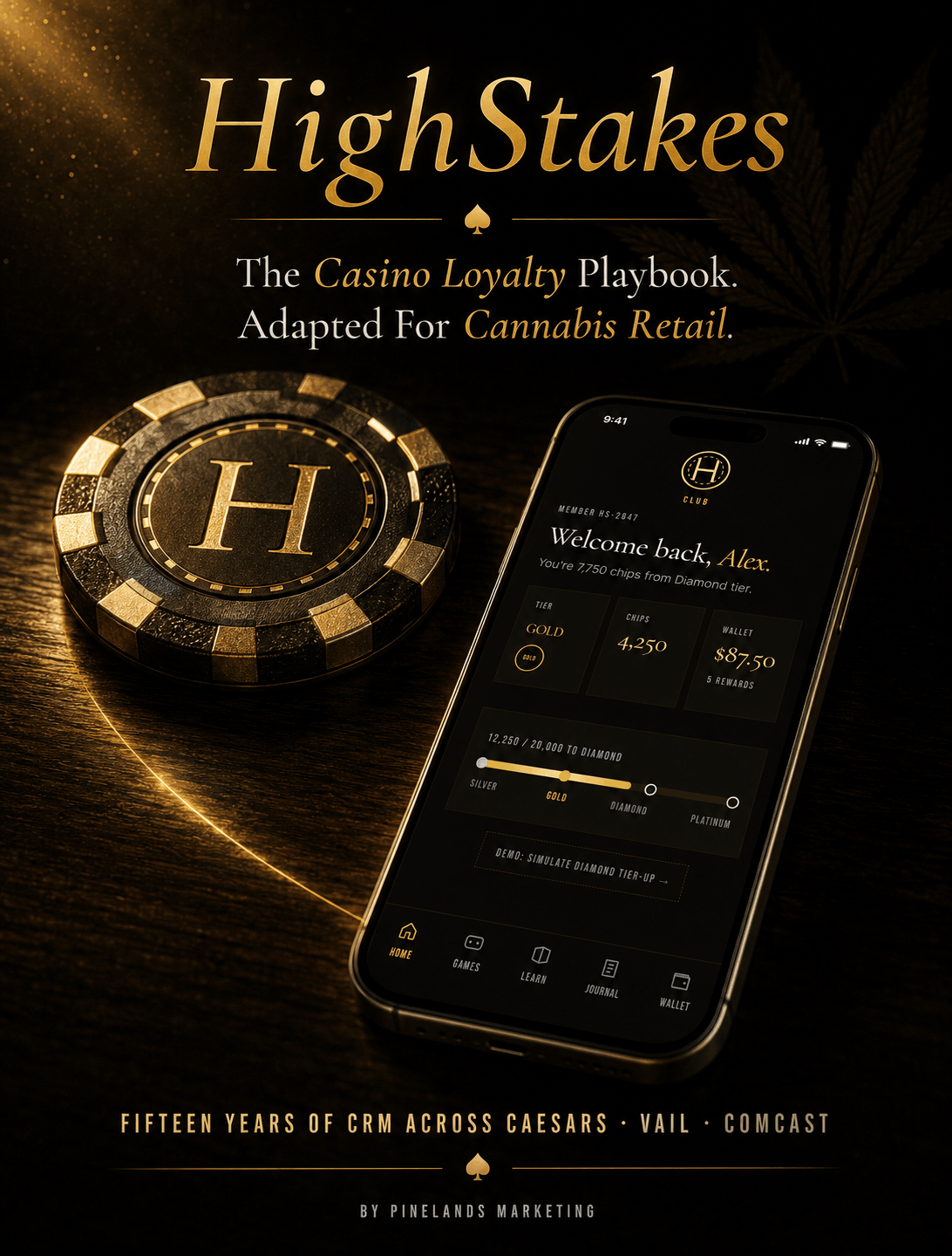
HighStakes is a VIP loyalty and gamification platform that layers on top of the cannabis loyalty stack operators already use. It's not a replacement for Alpine IQ or Klaviyo or Springbig. It's the experience layer that builds on top of them.
The platform includes free-to-play casino-style game mechanics (scratchers, spin wheels, slot machines), a chip economy that rewards purchases and engagement, product education modules that build real strain and product expertise, tier progression from Silver to Platinum, a persistent rewards wallet, and behavioral data that syncs back to the operator's existing CRM.
Two tiers: HighStakes Plays as an entry engagement layer for dispensaries that want to test gamification, and HighStakes Club as the full VIP loyalty platform with chip economy, education, journal, wallet, and tier-up moments.
The whole thing is white-labeled, customer-facing, and designed to make existing loyalty platforms more effective rather than to replace them.
If you're an operator with your loyalty data dialed in but you're not seeing the VIP engagement you'd expect from your top 20% customers, HighStakes is the layer worth building on top of what you already have.
You can preview the full Club experience at highstakesloyalty.com/club-preview or reach out directly to talk about whether it fits your operation.
The Bigger Point
Whether or not HighStakes is the right product for your dispensary, the underlying argument matters more than the specific product recommendation.
Cannabis retail has spent five years building the data infrastructure that retail needed. That work is impressive and it's not wasted. But the data infrastructure isn't the loyalty program. It's the foundation for the loyalty program.
The dispensaries that figure out what to build on top of that foundation in the next two years are going to define what cannabis retail looks like for the next decade.
The casino playbook works. Cannabis retail just needs to start running it.
Brett Hahn
Brett Hahn is the founder of Pinelands Marketing LLC, a strategic CRM and loyalty consultancy for cannabis retail. He spent the first half of his career building VIP loyalty programs at Caesars Entertainment, Vail Resorts, and Comcast before moving into cannabis CRM at C3 Industries, where he scaled customer relationships across 31 stores in six states. He is an Alpine IQ Certified Partner and Klaviyo Certified Partner. He builds HighStakes, the VIP loyalty platform cannabis retail has been missing, at highstakesloyalty.com.
Schedule a Consultation